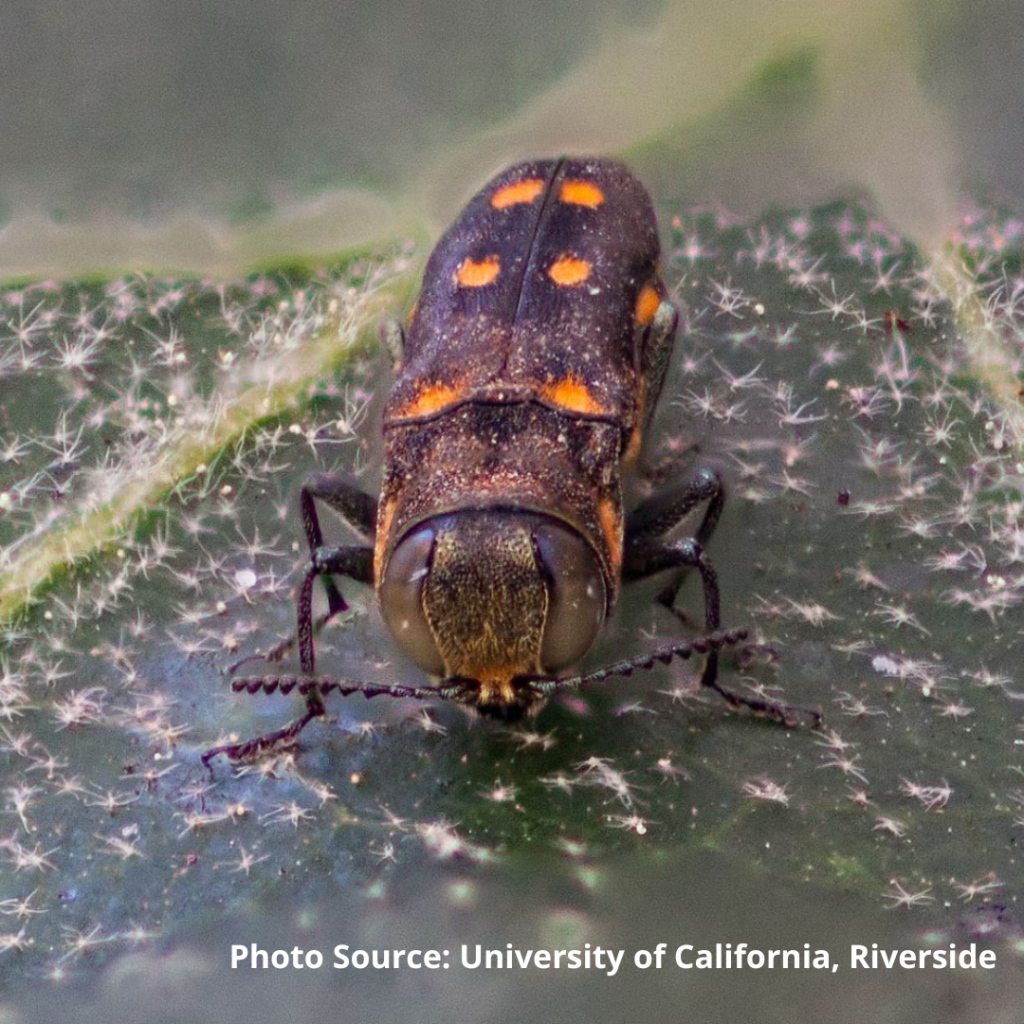
An insect only 10mm in size holds a detrimental effect on Ventura County’s mighty oak woodlands. Meet the Goldspotted Oak Borer (GSOB)— a tiny beetle native to Southeastern Arizona with six gold spots along its forewings. Adult GSOB feed on oak foliage, while larvae burrow into oaks and feed under the bark. According to UC Riverside Center for Invasive Species Research, “feeding larvae kill patches of cambium [a thin layer of generative tissue lying between the bark and the wood of a tree trunk], which eventually causes tree death.” Once development is complete, the adults chew a D-shaped hole through the bark about 3mm in width and exit the tree.
The beetle first appeared in California in San Diego County in 2004. Since then, GSOB has infested oaks in Riverside, Orange, San Bernardino, Los Angeles, and most recently, Ventura Counties. According to the University of California Agriculture and Natural Resources (UCANR), the expansion of GSOB across Southern California is likely attributed to the transport of infested oak firewood. Oak species impacted by GSOB include Coast Live Oaks, California Black Oaks, and Canyon Live Oaks. As noted by UCANR, evidence of GSOB attacks may be recognized by:
- D-shaped exit holes
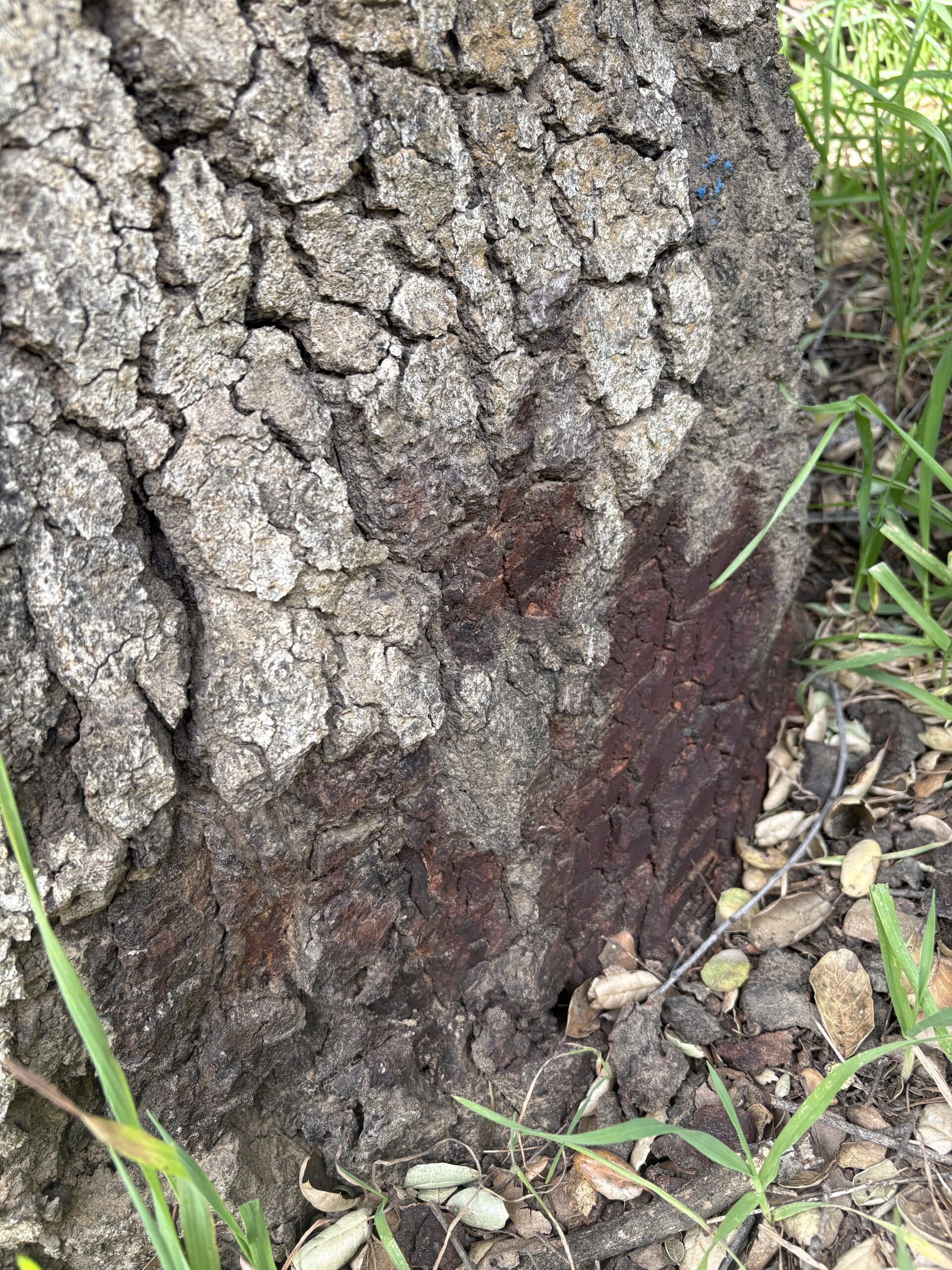
- Red or black bark staining
- Crown thinning
- Twig and branch die-back
- Premature leaf loss
- Blistering and oozing on the tree surface


Exit Holes
Bark Staining
Crown Thinning
Loss of mature oak species due to GSOB attacks holds several environmental, cultural, and economic impacts. Oaks are keystone species, holding a large impact on their ecosystem through providing food and shelter for wildlife. Not only are oaks important environmentally, but also culturally as they play a critical role in the cultural practices of Indigenous tribes. Additionally, dead and dying oaks increase fuel load, creating a more dangerous wildfire situation.
Current research findings note management options for both infested live trees and infested dead/down trees. According to UCANR, chemical treatment can be used in live oaks “to control low-level infestations in lightly damaged, high-value trees.” For dead and down oaks, management options include properly handling infested oak firewood to limit spread and treating infested wood through chipping, tarping, and debarking/drying.
So, what can you do to help the fight against GSOB? Report if you see symptoms of GSOB on oaks on your property or neighborhood, handle infested firewood properly (don’t move firewood), and stay informed through workshops, email-lists, and volunteer events like a GSOB Blitz hosted by UCANR. To learn more about GSOB, see the resources below.
Read more about the Goldspotted Oak Borer
Explore UC Riverside’s Center for Invasive Species Research GSOB site
Watch our Fire Ecology Webinar on Goldspotted Oak Borers presented by Jolene Tamm and Kim Corella
Register for a GSOB Blitz
Citations:
- Center for Invasive Species Research. The Goldspotted Oak Borer. University of California, Riverside, https://cisr.ucr.edu/invasive-species/goldspotted-oak-borer.
- The Value of Oaks. Garden Notes, University of California Agriculture and Natural Resources, 10 Sept. 2024, https://ucanr.edu/blog/garden-notes/article/value-oaks.
- University of California Agriculture and Natural Resources. About Goldspotted Oak Borer. Goldspotted Oak Borer, Regents of the University of California, https://ucanr.edu/site/goldspotted-oak-borer/about-goldspotted-oak-borer.
- University of California Agriculture and Natural Resources. Management Options. Goldspotted Oak Borer, Regents of the University of California, https://ucanr.edu/site/goldspotted-oak-borer/management-options.